For investors and owners seeking high-yield opportunities in Spanish hospitality, hotel repositioning continues to represent one of the most powerful levers for asset value creation in Spain, not only for individual properties or hotel portfolios, but also for the broader destinations in which they operate.
Why reposition?
Repositioning a hotel asset typically involves a comprehensive strategic overhaul designed to unlock untapped value. This process includes:
– Assessing current performance: Conducting a thorough analysis of the property’s existing market position, operational performance, and brand perception.
– Reviewing the market landscape: Evaluating local and regional trends, identifying demand drivers, analyzing underserved segments, growth opportunities, and benchmarking against competing assets.
– Measuring performance potential: Comparing current performance and achievable upside under a repositioning scenario.
– Defining the transformation path: Identifying the levers—product, brand, concept, guest mix—that will drive the transition, outlining the capex required and building a clear business case for repositioning.
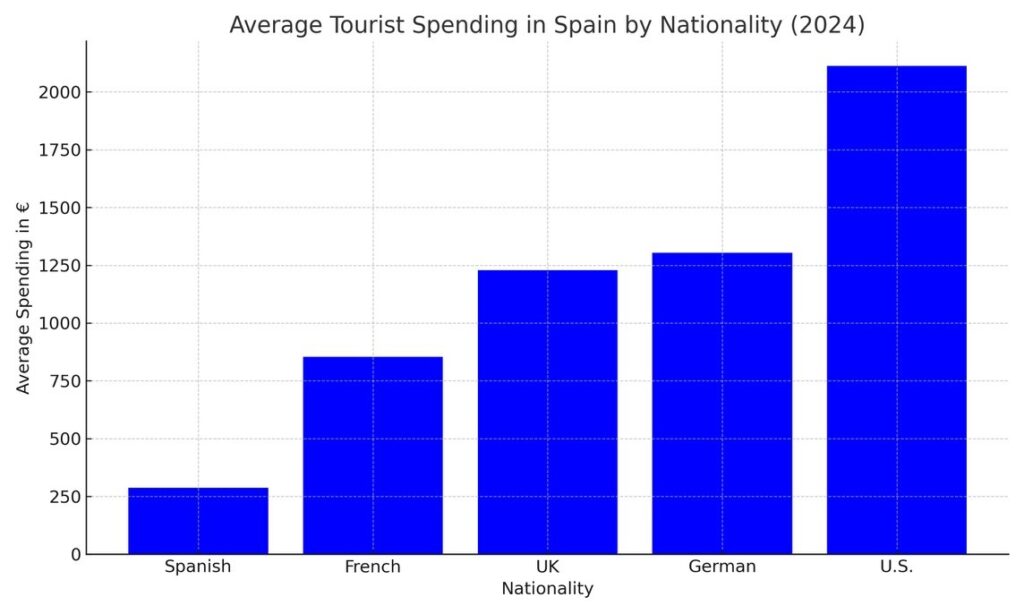
Total Stay Spending – Source: INE
A Key Driver: Shifting the Guest Mix
One of the most effective levers in repositioning is attracting a more international guest profile. Many underperforming assets are overly reliant on domestic markets with lower average spend and shorter average stay. By targeting international source markets, particularly high-spending ones like the U.S., owners can significantly enhance RevPAR and overall asset value.
This shift materially impacts profitability and asset valuation. Yet in Spain, this opportunity remains largely untapped. The six major global hotel groups (Hyatt, Accor, Marriott International, IHG Hotels & Resorts, Hilton, Wyndham Hotels & Resorts) account for only 2.7% of the country’s 16,778 hotels, highlighting a significant market inefficiency.
Repositioning’s Broader Payoff: multiplier effect on the local economy
Repositioning does not just boost the performance of individual assets, it also elevates the destination, creating positive synergies that benefits all stakeholders. Outcomes typically include:
– Extended seasonality: a higher international demand can help stretch the operating calendar length beyond traditional peak months.
– Event and MICE business: Upgraded hotels attract new event and conference opportunities that did not take place before in the destination.
– Improved labor dynamics: More stable demand leads to longer-term employment contracts, higher employee retention and more service consistency.
– Increased local spend: RevPAR gains are often mirrored by increased revenue in nearby restaurants and attractions.
– Knowledge transfer: Global brands bring in international standards and training programs, raising the skills level of local hospitality staff.
– Increased investment: Successful repositionings attract additional private and institutional investment, fueling further growth and development.
– Enhanced visibility: Stronger brands provide destinations with an amplified international marketing exposure, reinforcing their appeal globally.
The bottom line: value creation at multiple levels
For hotel owners, repositioning is not just a trend—it’s a high-impact investment strategy for those targeting outsized returns in Spain’s mature, yet fragmented, hospitality market.
Done right, repositioning enhances NOI, improves exit multiples, and creates scalable impact across entire destinations. For investors with a medium- to long-term horizon, this approach offers an exceptional balance of capital appreciation, income growth, and downside protection through destination development.