Asset Review
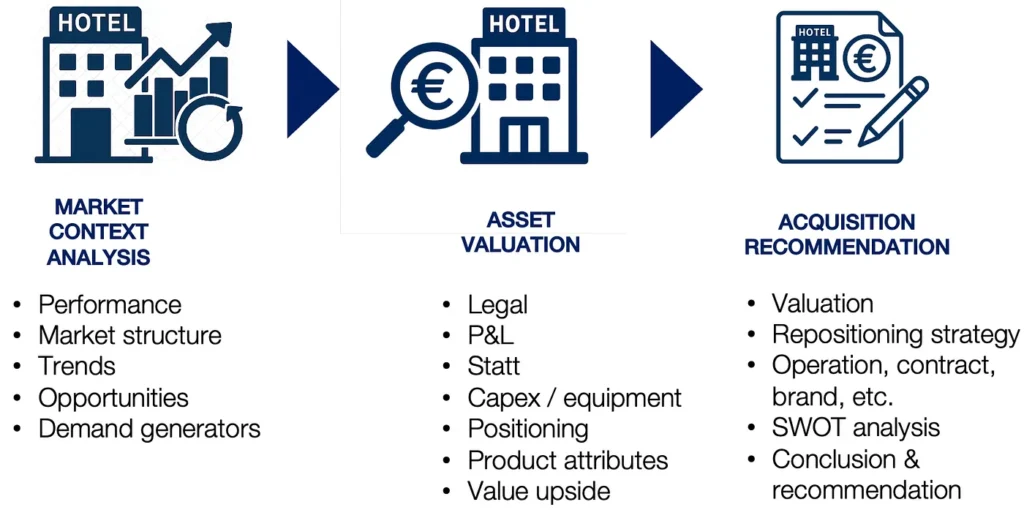
Secondly, once the market context of each asset has been established, we will address the key areas of each hotel property.
We will verify the legal and planning situation, analyse departmental results, assess the labour situation of each hotel, review the condition of the facilities through an engineering inspection, identify potential capex requirements, evaluate the business and commercial positioning of each hotel within its market, and determine the property’s goodwill and its potential value-creation upside.
Investment Recommendation Report
Finally, all the information gathered will be consolidated and the value of each asset will be determined using the most appropriate valuation methodologies in each case (discount rates, comparable transactions, multiples, replacement cost, etc.).
The final recommendation report will allow us to draw conclusions regarding the most suitable value-generation strategies for each asset, the optimal operating and commercial model, the efficiencies to be achieved, and other key considerations. A SWOT analysis will summarise the final recommendations regarding the advisability of proceeding with the acquisition and its estimated return.
In summary, conducting a hotel due diligence proves to be an essential and extremely valuable tool when facing a strategic decision of such magnitude as the acquisition of one or more hospitality real estate assets.
Beyond being a technical procedure, due diligence constitutes a knowledge-driven process that enables investors to minimise risk, maximise value and anticipate the future evolution of the asset within its competitive context.