The Spanish hotel market offers a rare combination of strong fundamentals, robust international demand, and capital appreciation, making it the most attractive sector in Spain for foreign investors seeking to diversify their portfolios. However, the tremendous imbalance between an increasingly large investment appetite and a high scarcity of assets at the right price, require a carefully planned approach to navigate this market successfully.
Probably the most attractive hotel market in the world
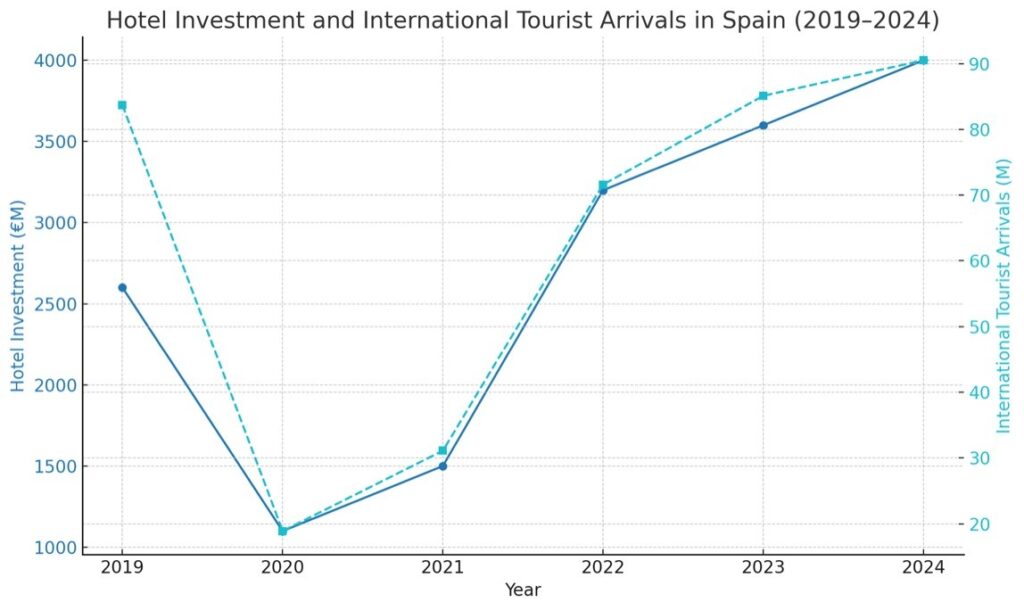
Spain continues to break tourism records. In 2023, it welcomed over 85 million international visitors, surpassing pre-pandemic highs, and it is expected to exceed 90 million arrivals in 2024. With consistent demand growth and increasing per capita spending by tourists, Spain is on the verge of becoming the world’s number one tourism destination, potentially overtaking France.
On the investment front, the Spanish market has ranked consistently top 3 in Europe and top 5 globally in terms of volume, with increasing interest from both domestic and international investors. Nationwide, hospitality remains the most attractive real estate vertical segment.
Sourcing properties in a highly competitive market
Despite the appeal, securing hotel assets in Spain is not easy. With so much capital chasing limited inventory, the competition is fierce, especially in top-tier urban gateways and in classic holiday destinations: Madrid, Barcelona, Valencia, Málaga, the Balearic Islands, Costa del Sol, etc.
In terms of timing, for investors unfamiliar with the local market, patience and preparation are key. Successful acquisitions often take several months of groundwork, networking, and due diligence. To try to minimise the scouting and bidding phases, it is strongly recommended to reach out to as many industry actors as possible with our specific acquisition requirements: hotel consultants, brokers, architects and lawyers. In this way, we will maximise our network of contacts and exposure to market intelligence. The largest international hotel brokerage and consulting firms operating in Spain include Cushman & Wakefield | Hospitality , Horwath HTL, Catella Spain, Colliers, Savills España, CBRE, Deloitte, Christie & Co and JLL.
However, the tremendous imbalance between an increasingly large investment appetite and a high scarcity of assets at the right price, require a carefully planned approach to navigate this market successfully.